



Across Europe and partner regions, communities are increasingly facing complex and overlapping crises, from natural hazards to environmental pressures and conflict-related disruption. In these moments, recovery is not defined by response systems alone, but by the capacity of communities to organise, adapt, and rebuild together.
Our Best Practice Guide and Case Study Compendium capture how communities respond to crisis through local leadership, shared responsibility, and practical innovation, offering a clear view of what effective, community-led recovery looks like in real contexts.
By combining structured analysis with grounded examples, our cases support learning, reflection, and application. It highlights approaches that are not only effective in their original setting, but also transferable and adaptable across different regions. In doing so, it reflects the core ambition of RISE: to strengthen the capacity of communities to move beyond recovery, and towards long-term resilience.
Through our case studies, we have highlighted tested approaches, transferable strategies, and showcased preparedness, recovery, and long-term adaptation across our partner countries. Designed for educators, community leaders, local authorities, and civil society organisations, it provides examples and inspiration that help drive innovation in community resilience and recovery.
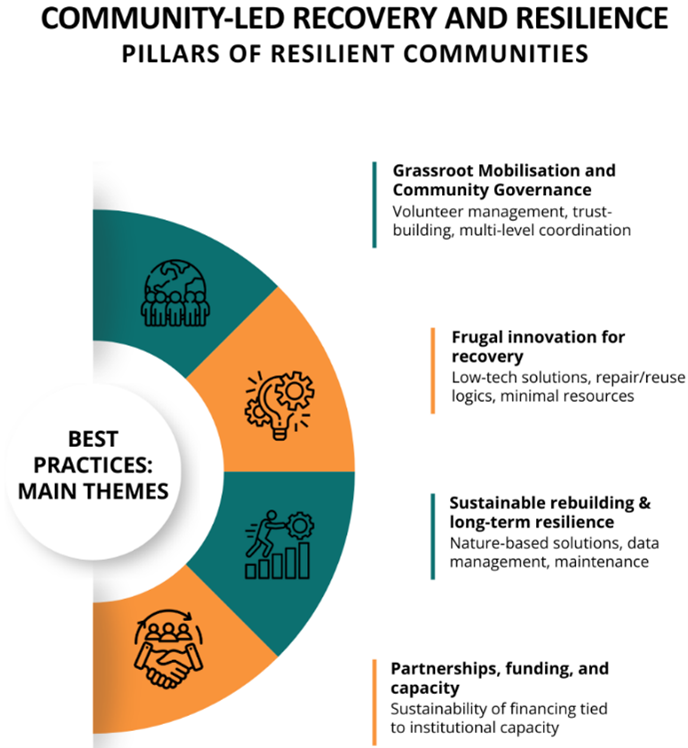
Drawing on diverse recovery experiences, this Guide provides a structured understanding of what enables effective, community-led recovery. It brings together key themes such as grassroots mobilisation, coordination, preparedness, frugal innovation, and sustainable rebuilding, offering a clear framework for action.
Rather than presenting isolated examples, it identifies patterns, lessons, and conditions for success, helping users understand what works and why. It supports informed decision-making and planning across sectors.
At its core, the Guide reinforces a key principle: resilience is not about returning to the past, but about building systems and communities that are better prepared for future challenges.
Grounded in real contexts, the Compendium presents a diverse set of examples showing how communities respond to disruption and rebuild over time. Each case study captures the journey from immediate response through to longer-term recovery and resilience-building.
Across the portfolio, common strengths emerge, including local knowledge, trusted networks, preparedness, and practical action under pressure. These examples highlight both innovation and challenge, providing a realistic view of recovery in practice.
By documenting approaches across different contexts, the Compendium supports transferability, enabling communities and organisations to apply relevant strategies within their own settings.

Unlike sudden disasters, conflict and war create disruption that is continuous, unpredictable, and deeply embedded in everyday life. Infrastructure is damaged over time, services become unreliable, and communities must function under constant uncertainty and pressure.
These case studies demonstrate how resilience is sustained through community-led action in the most challenging conditions. They show how local leadership, preparedness, and practical, low-resource solutions help maintain essential services and social cohesion. Recovery in this context is not a defined phase, but an ongoing process of adaptation, where communities play a critical role in sustaining stability and rebuilding over time.

Driven by extreme weather, floods and storms can rapidly overwhelm communities, cutting off access to power, water, transport, and communication. Their impacts are often compounded by repetition, leaving communities to recover while preparing for the next event.
These case studies highlight how community-led recovery strengthens both immediate response and long-term resilience. They show the importance of preparedness, trusted coordination, and practical solutions that keep communities functioning during disruption. By focusing on rebuilding that reduces future risk, they demonstrate how recovery can become a pathway to stronger, more resilient local systems.

With little to no warning, earthquakes can cause immediate and catastrophic destruction, collapsing buildings, disrupting infrastructure, and displacing entire populations within seconds. The scale and speed of impact leave communities facing urgent response needs alongside complex, long-term recovery challenges.
These case studies explore how resilience is built through a combination of preparedness, coordinated systems, and community-led action. They show how rebuilding efforts can move beyond restoration, prioritising safety, improved planning, and risk reduction. In this context, resilience is defined by the ability to rebuild stronger and reduce vulnerability to future shocks.

Fuelled by rising temperatures and changing climate conditions, wildfires can spread rapidly across large areas, destroying natural landscapes, homes, and livelihoods. Their effects extend far beyond the immediate event, with long-term consequences for ecosystems, economies, and community stability.
These case studies focus on recovery approaches that prioritise sustainable rebuilding and long-term resilience. They highlight how preparedness, land management, and community-led action can reduce vulnerability and support adaptation. By linking recovery with environmental stewardship, they show how communities can rebuild in ways that are more resilient to future climate pressures.

Not all crises unfold suddenly. Environmental disasters such as drought, heatwaves, and ecosystem degradation develop over time, gradually placing pressure on resources, livelihoods, and community wellbeing. Their impact can be less visible, but equally disruptive and long-lasting.
These case studies highlight the importance of adapting to slow-moving but persistent challenges. They show how community-led approaches, preparedness, and sustainable practices support resilience in changing conditions. By focusing on long-term adaptation and working with natural systems, they offer practical strategies for building stability in the face of ongoing environmental change.