

When we think about innovation in disaster resilience, it is easy to imagine advanced technology, artificial intelligence, sensors or complex emergency systems.
But sometimes one of the most effective solutions is much older.
Across Spain and Portugal, European projects are rediscovering traditional farming and land management practices as a way to reduce wildfire risk.
A new article published by the European Climate, Infrastructure and Environment Executive Agency on 17 September 2026 highlights several LIFE projects that are using grazing, agroforestry, sustainable forestry and landscape restoration to create environments that are more resistant to wildfire.
The message is highly relevant to RISE Resilient Communities:
innovation does not always mean inventing something completely new. Sometimes it means recognising the value of knowledge communities already have and adapting it to today’s risks.
Original article:
https://cinea.ec.europa.eu/news-events/news/life-projects-support-europes-fight-against-wildfires-2026-09-17_en
Europe experienced another severe wildfire season in 2026.
By mid August, almost 700,000 hectares had already burned, according to the European Commission article. The EU response included more than 700 firefighters, 200 vehicles and 38 aircraft deployed to support affected countries.
Emergency response on this scale remains essential.
But Europe is also increasingly recognising that fighting fires after they begin cannot be the only strategy.
Communities and land managers need ways to reduce the conditions that allow fires to become so destructive in the first place.
This means looking at the landscape itself.
Dry vegetation, abandoned farmland and unmanaged forests can provide large amounts of fuel for wildfires. Changes in rural populations and traditional farming practices can therefore influence how vulnerable an area becomes.
Preventing wildfire can begin with managing that fuel before temperatures rise and fires start.
One example comes from northern Portugal through the LIFE MARONESA project.
The project is responding to the abandonment of mountain pastures and community land. When land is no longer actively managed, vegetation can accumulate and provide additional fuel during dry summer conditions.
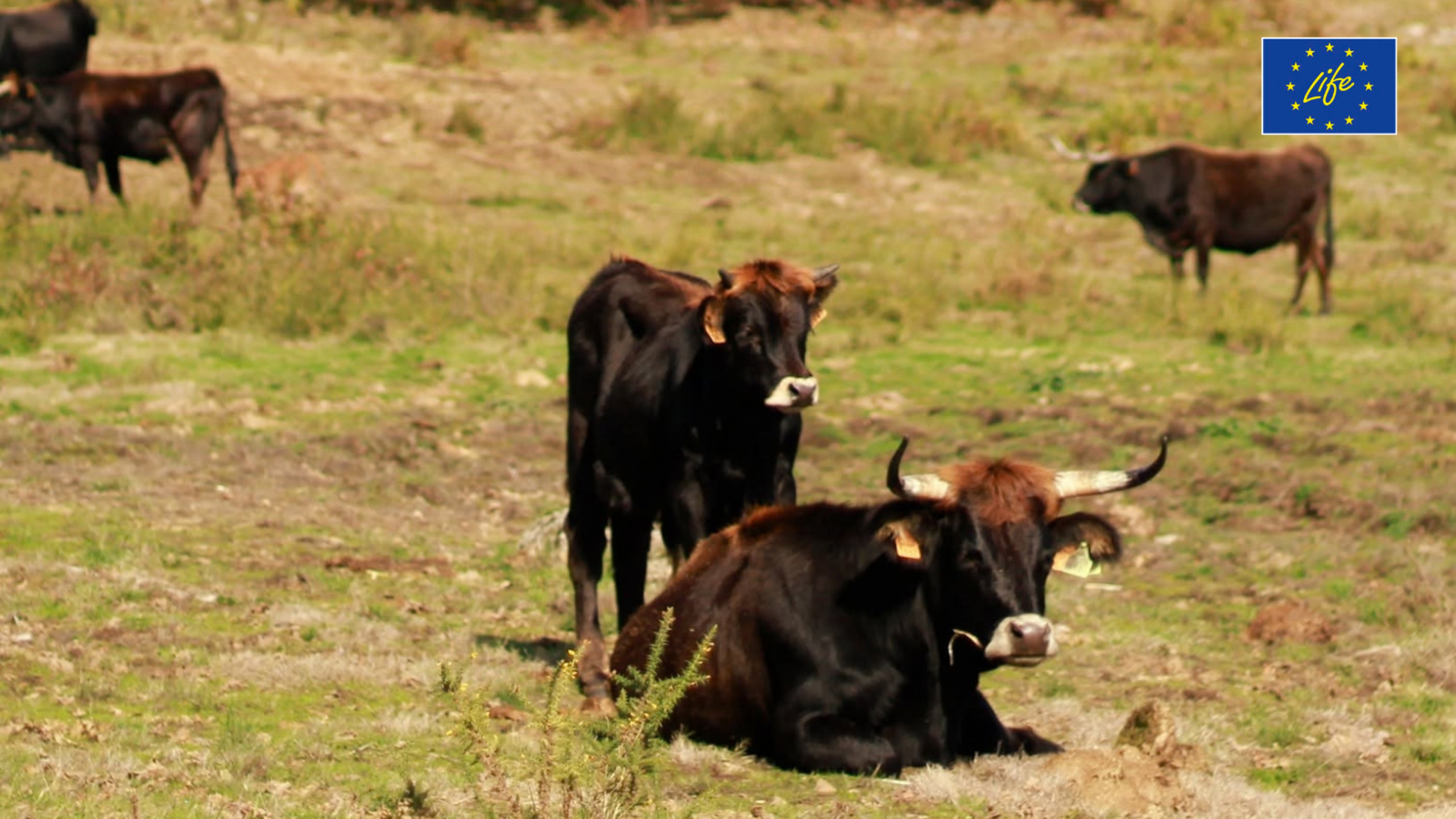
The project encourages farmers to return traditional Maronesa cattle to these landscapes.
As the animals graze, they naturally reduce vegetation while also contributing to soil quality and carbon storage.
A 209 hectare demonstration farm has already tested this approach, and the model is now being replicated in several other areas of northern Portugal.
This is a simple idea with a wider lesson.
The animals are not only part of agricultural production. Their presence also contributes to managing the landscape and reducing wildfire risk.
Another Portuguese initiative, LIFE ResLand, is working across 963 hectares of the Sintra Cascais Natural Park.
The project is testing different approaches to creating what it calls a more resilient and “firewise” landscape.
Measures include grazing with sheep, goats and donkeys, removing invasive species, restoring wetlands and introducing more sustainable forestry practices.
More than 37,000 native adapted plants have already been raised and planted, while over 1,000 landowners, farmers and family members are involved.
This is important because wildfire resilience is not only a task for emergency services.
Farmers, landowners, communities and local organisations can all contribute to prevention.
In Spain, the LIFE AgroForAdapt project is demonstrating another approach.
The project promotes agroforestry, where agricultural activity and trees are managed together.
Two methods are being explored.
One combines crops with rows of trees.
The other combines livestock grazing with forested land.
These approaches can help create more varied landscapes rather than large continuous areas of unmanaged vegetation. This can contribute to reducing wildfire risk while also supporting biodiversity, soil quality and agricultural activity.
The project has signed 76 agreements with farms covering more than 850 hectares of demonstration plots.
Importantly, participants are also exploring whether these practices can provide economic opportunities alongside their environmental benefits.
That matters for long term resilience.
A prevention measure is much more likely to continue when it also works for the people and businesses managing the land.
These examples reflect an important principle within RISE Resilient Communities: frugal innovation.
Frugal innovation is about finding practical solutions that achieve meaningful results without depending on expensive or highly complex systems.
The idea is not to reject technology.
It is to ask a different question:
What is the simplest effective solution available within this community?
Sometimes the answer may be a digital warning system.
Sometimes it may be better communication between community groups.
And sometimes it may be livestock grazing on land that would otherwise become overgrown.
For RISE, resilience is strongest when solutions are practical, accessible and rooted in local circumstances.
There is another lesson within these projects that is particularly important.
Traditional land management represents knowledge developed through generations of living and working within particular landscapes.
Farmers and rural communities often understand how vegetation changes through the seasons, where water collects, how animals interact with the land and how different management practices affect local ecosystems.
As communities modernise and rural populations change, some of this knowledge can be lost.
Yet climate change is showing that parts of it may be increasingly valuable.
The challenge is not to return blindly to the past.
It is to combine local experience with modern research, technology and environmental knowledge.
This creates a form of innovation that is both forward looking and grounded in what communities already know.
This is also the thinking behind the RISE approach.
The project does not assume that every community needs to develop its own resilience solutions from the beginning.
Instead, RISE helps communities learn from approaches that have already been tried elsewhere.
The RISE Best Practice Guide identifies practical examples of disaster preparedness and recovery from across Europe.
The Case Study Compendium documents real experiences involving wildfires, floods, storms, earthquakes, conflict and environmental disasters.
The Digital Toolbox provides accessible tools for preparedness, coordination, communication and longer term recovery.
Together, these resources allow educators, community leaders and grassroots organisations to ask:
What has worked elsewhere?
Why did it work?
Could it work here?
How would we need to adapt it to our own community?
This process of adaptation is central to resilience.
A solution that works in northern Portugal may not transfer directly to another region, but the principle behind it may still inspire a useful local approach.
Wildfire preparedness is sometimes viewed mainly through the lens of firefighting.
But prevention involves a much wider group of people.
Farmers can manage vegetation.
Landowners can reduce fuel accumulation.
Local authorities can support landscape planning.
Community organisations can raise awareness.
Educators can help people understand changing risks.
Residents can learn how their own actions affect wildfire vulnerability.
Emergency services remain essential, but they are part of a much wider resilience system.
This is why RISE places such a strong emphasis on education and community participation.
People are better able to contribute to resilience when they understand the risk and know what practical action they can take.
The examples emerging from Spain and Portugal challenge the idea that resilience always requires something new or expensive.
Goats reducing dry vegetation.
Cattle maintaining mountain pastures.
Farmers combining trees and crops.
Communities restoring wetlands.
These may seem like simple interventions.
But together they can contribute to landscapes that are healthier, more economically useful and less vulnerable to severe wildfire.
The wider lesson extends far beyond fire.
Communities already have knowledge, experience and resources that can become part of disaster preparedness.
The task is to recognise them, strengthen them and combine them with new ideas where they can make the greatest difference.
That is very much the approach behind RISE.
By bringing together practical learning, real community experiences and low cost, high impact solutions, RISE is helping communities see resilience not simply as something delivered to them, but as something they can actively build.
RISE Best Practice Guide:
https://resilientcommunitiesrise.eu/best-practice-guide/
RISE Digital Toolbox:
https://resilientcommunitiesrise.eu/digital-toolbox/
RISE Case Study Compendium:
https://resilientcommunitiesrise.eu/case-study/
Explore RISE:
https://resilientcommunitiesrise.eu/