

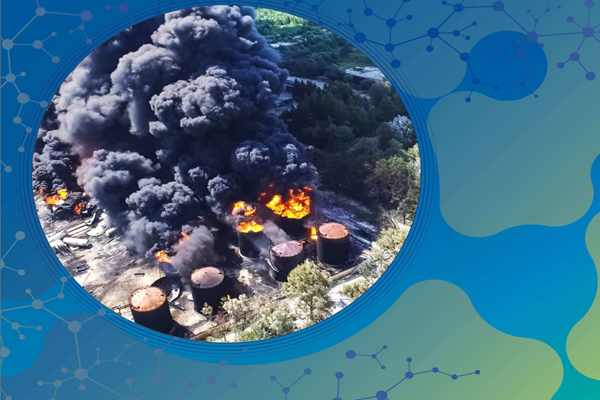
What will communities need in order to prepare for disasters in the years ahead?
That is the question at the centre of a new European Commission study published on 22 September 2026.
The Joint Research Centre, with support from the European Commission’s Directorate General for Migration and Home Affairs, has looked ahead to 2040 to explore how Europe can strengthen its disaster resilience.
The study considers a future where climate related hazards, security threats and weaknesses in critical infrastructure may increasingly overlap. It also explores the technologies and capabilities that could help Europe prepare for these more complex risks.
Original European Commission article:
https://home-affairs.ec.europa.eu/news/strengthening-eus-future-disaster-resilience-2026-09-22_en
For RISE, this raises an important question.
As disaster preparedness becomes more technologically advanced, how do we make sure communities themselves remain at the centre of resilience?
Communities rarely experience risks in isolation.
A severe storm can damage electricity networks, disrupt communications, interrupt water supplies and isolate vulnerable residents at the same time.
Flooding can affect homes, transport, local businesses and public services.
Wildfires can create immediate danger while also damaging livelihoods, ecosystems and tourism for months or years afterwards.
The European Commission’s new foresight study reflects this changing environment. It considers how different hazards and vulnerabilities may interact and potentially place greater pressure on existing preparedness systems by 2040.
Preparing for the future therefore means thinking beyond individual hazards.
It means asking how communities, authorities and organisations can continue functioning when several systems are affected at once.
One of the major themes of the European study is the role of emerging technology.
The report explores capabilities including advanced sensing systems, artificial intelligence, digital mapping and other technologies that could improve situational awareness, risk assessment and emergency response.
These developments could make a real difference.
Better data can help identify risks earlier.
Digital mapping can support planning and emergency coordination.
Artificial intelligence may help analyse large amounts of information more quickly.
Warning technologies can give communities valuable time to act.
But technology alone cannot create resilience.
A warning is only useful if people understand what it means.
A digital platform only works if organisations know how to use it.
Information only helps when communities trust the source.
And even the most advanced emergency system still depends on people being prepared to act.
This is where the RISE approach becomes particularly relevant.
RISE helps communities prepare for, respond to and recover from disasters through practical adult education, digital learning and community led action. The project focuses on simple, usable steps that help people understand risks, act sooner and recover more effectively.
Rather than viewing technology as a solution on its own, RISE looks at how tools can support people.
Its Digital Toolbox, for example, brings together free or low cost tools that can support communities across four areas:
Preparedness, Access and Risk Readiness
Coordination, Response and Resource Management
Recovery, Rebuilding and Long Term Resilience
Communication, Information and Community Trust
The emphasis is deliberately practical. The tools are intended for community members, volunteers, educators and local organisations, including people without specialist technical knowledge.
This is an important principle for the future of disaster resilience.
Innovation needs to be accessible if communities are expected to use it.
Future preparedness also means recognising that digital systems may not always be available.
Power cuts, damaged telecommunications infrastructure or overloaded networks can quickly affect the technologies people normally rely on.
Communities therefore need more than digital tools.
They need plans.
They need trusted contacts.
They need people who understand their roles.
They need alternative ways of communicating.
And they need the confidence to make decisions when normal systems are disrupted.
This is why RISE combines digital innovation with education and community capacity building.
The objective is not simply to give communities more tools. It is to help them understand when, why and how to use them.
Preparing for 2040 does not mean starting from zero.
Communities across Europe have already experienced floods, storms, wildfires, earthquakes, environmental disasters and conflict related disruption.
There is valuable knowledge within those experiences.
The RISE Best Practice Guide brings together examples of community led recovery and identifies approaches that can be adapted elsewhere.
It examines themes including grassroots mobilisation, community governance, frugal innovation, sustainable rebuilding, partnerships and long term capacity.
The RISE Case Study Compendium takes this further by documenting real community experiences across different hazards and regions.
Importantly, the cases are designed to be transferable. Communities can examine what worked elsewhere and consider what might be useful within their own circumstances.
Future resilience therefore depends on looking both forward and backward.
We need to understand emerging risks and technologies, while also learning from what communities have already experienced.
Foresight should not only happen at European or national level.
Communities can practise it too.
Local leaders, educators and community organisations can ask simple questions:
What risks could affect our area in the next five, ten or fifteen years?
Who might be most vulnerable?
Which services would we struggle to operate without?
How would we communicate if normal channels failed?
Which organisations could help?
What knowledge or skills are currently missing?
What affordable actions could we take now?
These conversations can help turn future risk from something abstract into something communities can prepare for.
This is closely aligned with RISE, which explicitly supports communities in developing the ability to anticipate risks rather than only react to them.
Thinking about 2040 can easily lead to images of highly advanced technology.
But resilience will also depend on simpler solutions.
A neighbourhood contact list.
A clearly communicated evacuation plan.
A trained volunteer network.
A community workshop.
An offline communication option.
A simple system for identifying vulnerable residents.
RISE places particular emphasis on low cost, high impact solutions because resilience needs to be achievable for communities with different levels of funding and technical capacity.
This is also central to the project’s developing Innovation for Impact work.
Through its Innovation Lab approach, educators, local leaders and innovators will work together to create and test practical solutions that communities can use and adapt.
The European Commission’s new study reminds us that the disaster landscape of 2040 may look different from the one we know today.
Technology will develop.
Climate risks will continue to change.
Communities may face new combinations of threats.
But one principle is unlikely to change:
prepared communities are better placed to respond.
Future disaster resilience will require technology, strong institutions and effective emergency services.
It will also require informed residents, confident community leaders, trusted networks and practical learning.
That is where RISE is making its contribution.
By combining education, real world experience, digital tools and community led innovation, RISE is helping communities build the skills they need not only for the next emergency, but for the changing risks of the years ahead.
RISE Digital Toolbox:
https://resilientcommunitiesrise.eu/digital-toolbox/
RISE Best Practice Guide:
https://resilientcommunitiesrise.eu/best-practice-guide/
RISE Case Study Compendium:
https://resilientcommunitiesrise.eu/case-study/